
There is a moment in competitive mobile gaming that separates the good players from the great ones. It happens in a fraction of a second — the instant between spotting an enemy and pulling the trigger. At 60 frames per second, that moment carries a small but measurable lag between what your brain registers and what appears on screen. At 90 frames per second, that gap narrows. At 120, it nearly disappears. Professional players noticed this difference long before the smartphone industry started marketing high refresh rate displays as premium features. They did not need a spec sheet to tell them what their hands and eyes were already feeling.
It Was Never Just About the Numbers
Walk into any serious BGMI or Call of Duty Mobile tournament in India and look at what the top players are carrying. You will not find them clutching budget phones with plastic builds and 60Hz panels. You will find OnePlus devices, ASUS ROG Phones, and Xiaomi flagships — machines built around one core promise: that what happens on screen will match what the player intends with their fingers as closely as physics allows. But ask those players why they chose 90 FPS over 60 and most of them will not talk about refresh rates or milliseconds. They will talk about how the game feels. Smooth. Alive. Responsive. Like the phone is listening.
That feeling is not marketing language. It is the result of something very real happening inside the display hardware and the processor simultaneously. At 60 FPS, the screen updates 60 times every second. At 90 FPS, it updates 90 times. That extra 30 frames does not sound dramatic on paper but in a game where a single frame can be the difference between landing a headshot and missing it entirely, those additional updates mean the on-screen action is always closer to real time. The enemy you see is not where they were half a second ago. They are where they are right now.
What Pro Players Actually Feel Behind the Screen
Mortal, one of India’s most recognized BGMI players, once described the shift from 60 to 90 FPS in an interview not with technical language but with a single word — clarity. Not visual clarity in the traditional sense of sharper pixels or better color. Perceptual clarity. The confidence of knowing that when you move your crosshair, the crosshair has actually moved. There is no ghost of a delay haunting your muscle memory.

This is what performance coaches working with esports athletes call input-to-output synchronization. Your thumb issues a command. The processor interprets it. The display renders it. The entire chain needs to happen fast enough that your brain experiences it as instant. At 60 FPS, trained competitive players can feel the seam in that chain. They describe it as a kind of stickiness — a sensation that the game is slightly behind them. At 90 FPS, that seam closes. At 120, it essentially vanishes for all but the most elite players whose reaction times are measured in the low hundreds of milliseconds.
The Hardware Arms Race Nobody Was Expecting
Five years ago, 90 Hz displays were a luxury feature found only in a handful of expensive flagship phones. Today they are standard on mid-range devices, and the credit for that shift belongs partly to the mobile gaming community. Competitive players and content creators pushed back loudly against the industry norm of 60 Hz, and manufacturers listened — not out of generosity but because the data was undeniable. Retention rates, session lengths, and in-app purchase behavior all improved on higher refresh rate devices. The business case for 90 FPS aligned perfectly with what players had been demanding for years.
Qualcomm’s Snapdragon series and MediaTek’s Dimensity chips both began optimizing specifically for sustained high frame rate performance around this period. The challenge was never simply achieving 90 FPS in a controlled benchmark environment. Any sufficiently powerful processor can hit those numbers in a lab. The real engineering problem was sustaining 90 FPS for 45 minutes of intense gameplay without the phone throttling due to heat, dropping frames during complex combat sequences, or destroying the battery in under two hours. This is where the gap between a gaming phone and a regular flagship becomes brutally clear.
Thermal Management is the Hidden Story
The conversation around 90 FPS almost always focuses on the display. Rarely does it go where the real story lives — inside the thermal management system. Heat is the silent enemy of high frame rate gaming. When a processor runs at full performance for extended periods, it generates heat. When heat builds beyond a threshold, the chip begins to throttle — deliberately slowing itself down to avoid damage. The moment throttling begins, frame rates drop. And the moment frame rates drop in a competitive match, the player who was running at 90 FPS suddenly finds themselves at 55, then 48, their advantage evaporated mid-gunfight.
The ASUS ROG Phone series became the gold standard for competitive mobile players not because it has the highest benchmark scores — it often does not — but because its vapor chamber cooling system maintains consistent performance for longer than almost any other device on the market. Pro players running three-hour scrimmage sessions on ROG Phones report far fewer instances of mid-game throttling compared to standard flagships. When you ask them why they chose that phone, they will say it stays smooth the whole time. What they are describing, without knowing the engineering term for it, is sustained thermal performance.
The Psychological Edge Is Real Too
Beyond the technical advantages, there is a psychological dimension to 90 FPS gaming that competitive coaches have begun taking seriously. Players who know they are on optimal hardware report higher confidence going into matches. They make faster decisions. They are less likely to second-guess a missed shot because they trust that their aim was the variable, not their equipment. This is not a small thing. In high-stakes esports, mental state is a decisive factor. Players who carry doubt about their tools into a match are already operating at a disadvantage before the match even begins.
Conversely, players who experience frame drops mid-match — even brief, momentary ones — show measurable hesitation in their subsequent decision-making. Esports performance researchers have documented this in studies tracking eye movement, decision timing, and shot accuracy before and after a lag spike. The body interprets inconsistent performance feedback as environmental unpredictability and responds with caution. A player in caution mode is not an aggressive, confident player. In a game like BGMI or Free Fire where aggression and timing are everything, caution is often the thing that gets you killed.
Why India’s Competitive Scene Specifically Drove This Shift
India deserves particular credit for accelerating the 90 FPS standard in mobile gaming. With one of the largest and fastest-growing competitive mobile gaming communities in the world, Indian players pushed device manufacturers to optimize for the specific demands of games like BGMI, Free Fire MAX, and Call of Duty Mobile. The market pressure from this audience — deeply price-conscious but increasingly performance-aware — forced brands like Xiaomi, Realme, and Poco to bring high refresh rate displays and gaming-optimized processors into the sub-20,000 rupee segment far faster than global trends would have suggested.
Indian esports organizations began specifying minimum device requirements for their roster players as early as 2021. Teams like GodLike, Skylightz, and S8UL started mandating 90Hz capable devices for practice sessions, recognizing that players who trained on 60 FPS phones were essentially training with a handicap. The muscle memory developed at 60 FPS does not transfer perfectly to 90 FPS match conditions. Every serious team coach in the Indian mobile esports ecosystem understands this now. The phone is not just a tool. It is part of the athlete’s environment. And environment shapes performance.
The Diminishing Returns Debate
A fair and honest examination of this topic has to address the question that hardware skeptics raise — does the human eye actually benefit from anything beyond 90 FPS? The scientific answer is complicated and depends heavily on the individual. Research on human visual perception suggests that most people can detect differences in motion smoothness up to around 150 Hz under controlled conditions, with highly trained individuals sometimes perceiving differences beyond that threshold. For most competitive mobile gamers, the jump from 60 to 90 FPS is significant and undeniable. The jump from 90 to 120 FPS is real but smaller. Beyond 120, the returns diminish rapidly for the vast majority of players.
This is precisely why 90 FPS has become the sweet spot that professional players and game developers have settled around. It delivers a transformative improvement over the 60 FPS baseline while remaining achievable without the extreme hardware demands of 144 Hz or 165 Hz displays. Games like BGMI and COD Mobile were optimized with 90 FPS as a target ceiling for competitive play, which means the game engine itself is tuned to deliver its best experience at that frame rate. Going above it offers marginal benefit in these specific titles. Staying below it means leaving a real and measurable competitive advantage on the table.
What This Means for Players Who Are Not Yet Pro
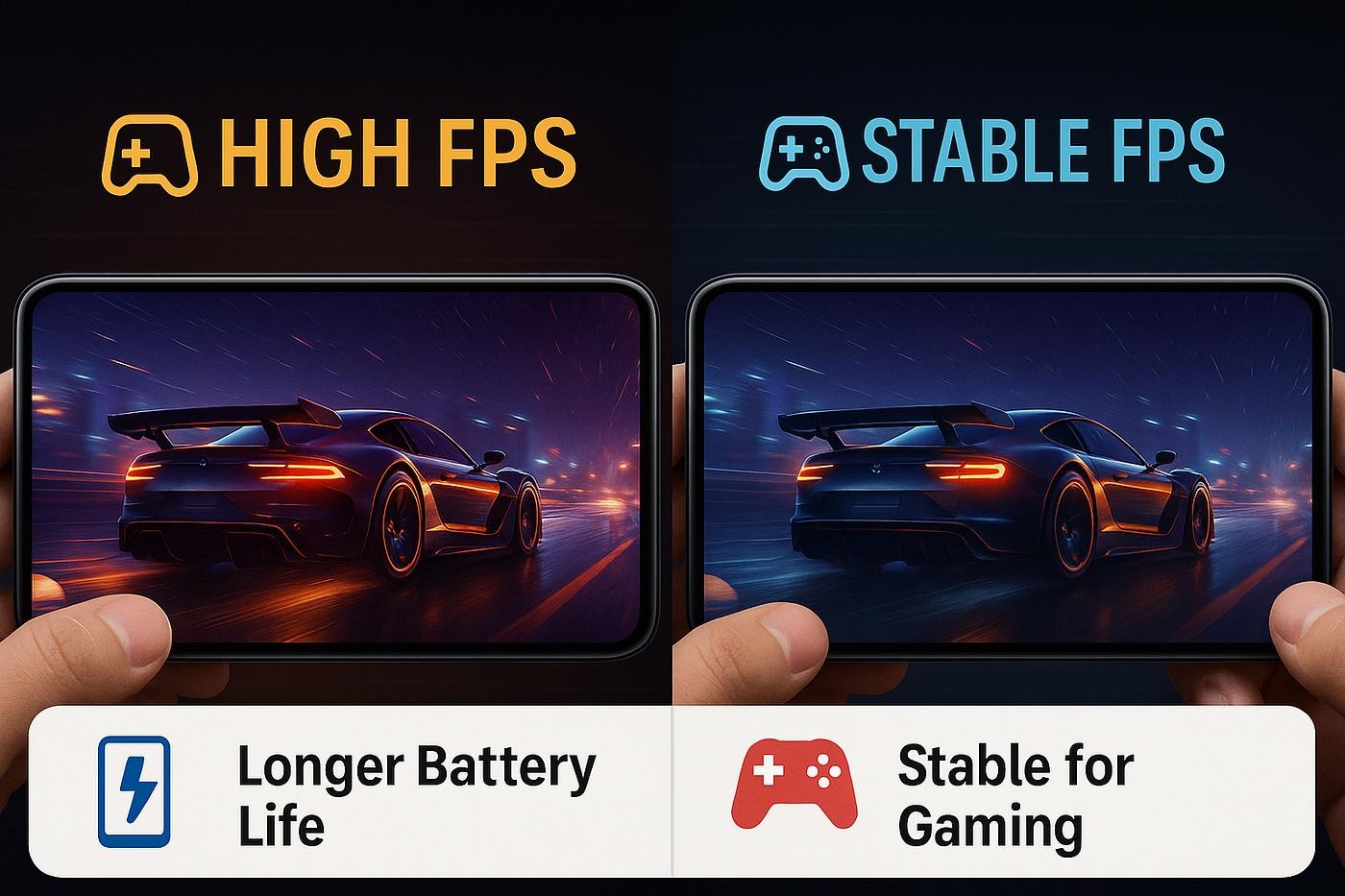
The takeaway from watching how professional players approach device selection is not that you need to spend fifty thousand rupees on an ASUS ROG Phone to be competitive. It is that frame rate consistency matters more than peak frame rate on a spec sheet. A phone that sustains 85 to 90 FPS throughout a match will serve a competitive player far better than a phone that claims 120 FPS capability but throttles to 60 after fifteen minutes of intense gameplay. Before buying a gaming phone, look for thermal throttling benchmarks. Look for sustained performance tests, not peak benchmarks. Read reviews from people who have played three-hour sessions, not five-minute demos.
The pro players figured this out through thousands of hours of practice, trial and error, and the kind of obsessive attention to performance that competitive gaming demands. They prefer 90 FPS phones not because someone told them to. Not because of a sponsorship deal. They prefer them because their bodies told them the truth long before any benchmark confirmed it — that smoother frames mean sharper reactions, and sharper reactions mean more wins. In a world where milliseconds determine outcomes, that preference is not a preference at all. It is a necessity.

